

IP cameras now account for over 64% of the global surveillance camera market, according to Omdia industry data. Yet analogue CCTV systems - particularly modern HD-TVI and HD-CVI variants - still sell in the millions every year. The reason is straightforward: choosing between IP and analogue is not a simple matter of "new versus old." It is a trade-off between resolution, cost, cable infrastructure, cybersecurity risk, and whether you actually need the AI-powered analytics that only IP can deliver. This guide walks through every factor that matters, with real prices and honest installer perspective.
(Omdia, 2025)
market ($42B / £34B, MarketsandMarkets)
existing analogue systems
IP Cameras vs Analogue CCTV: Resolution and Image Quality
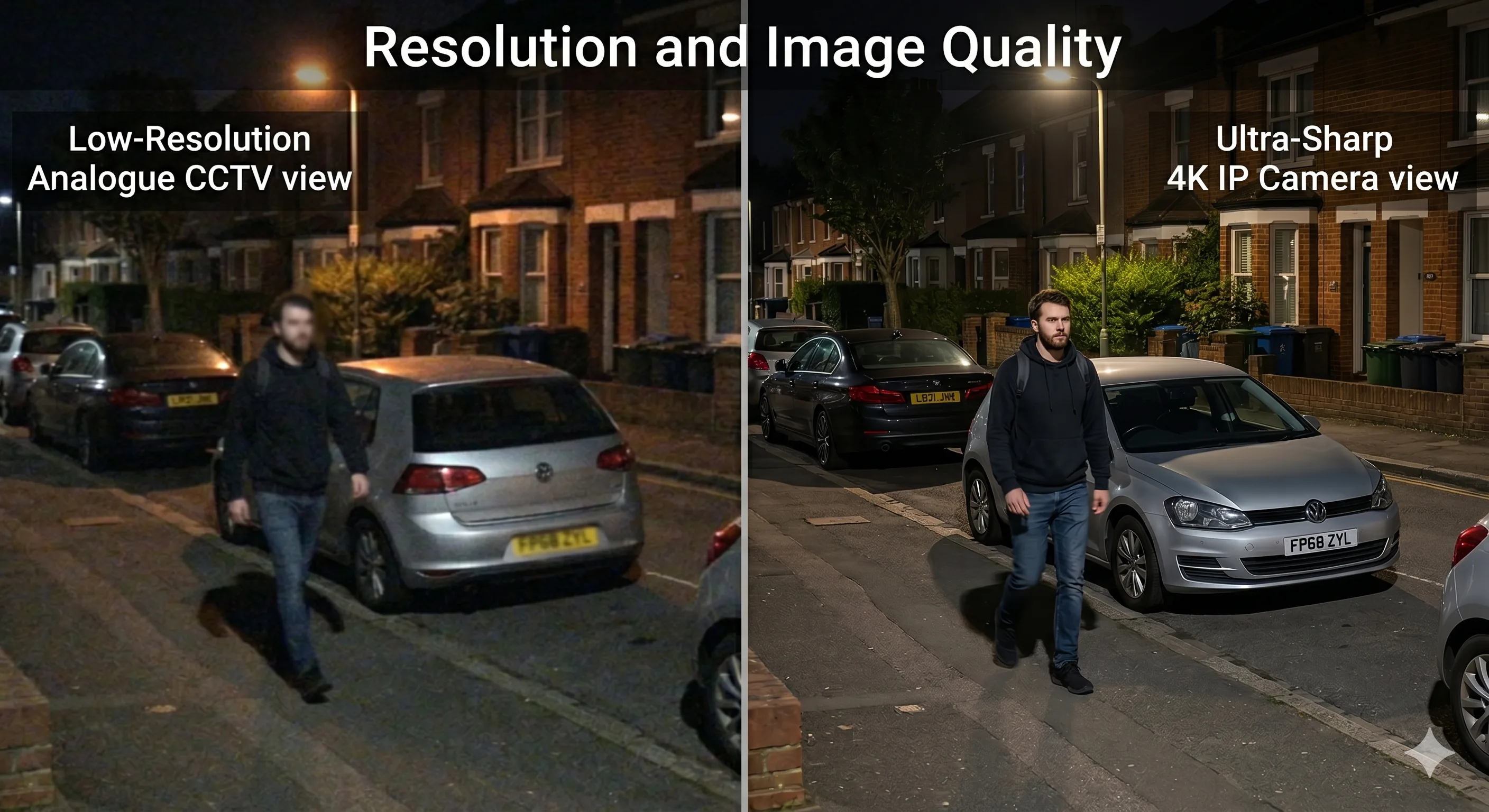
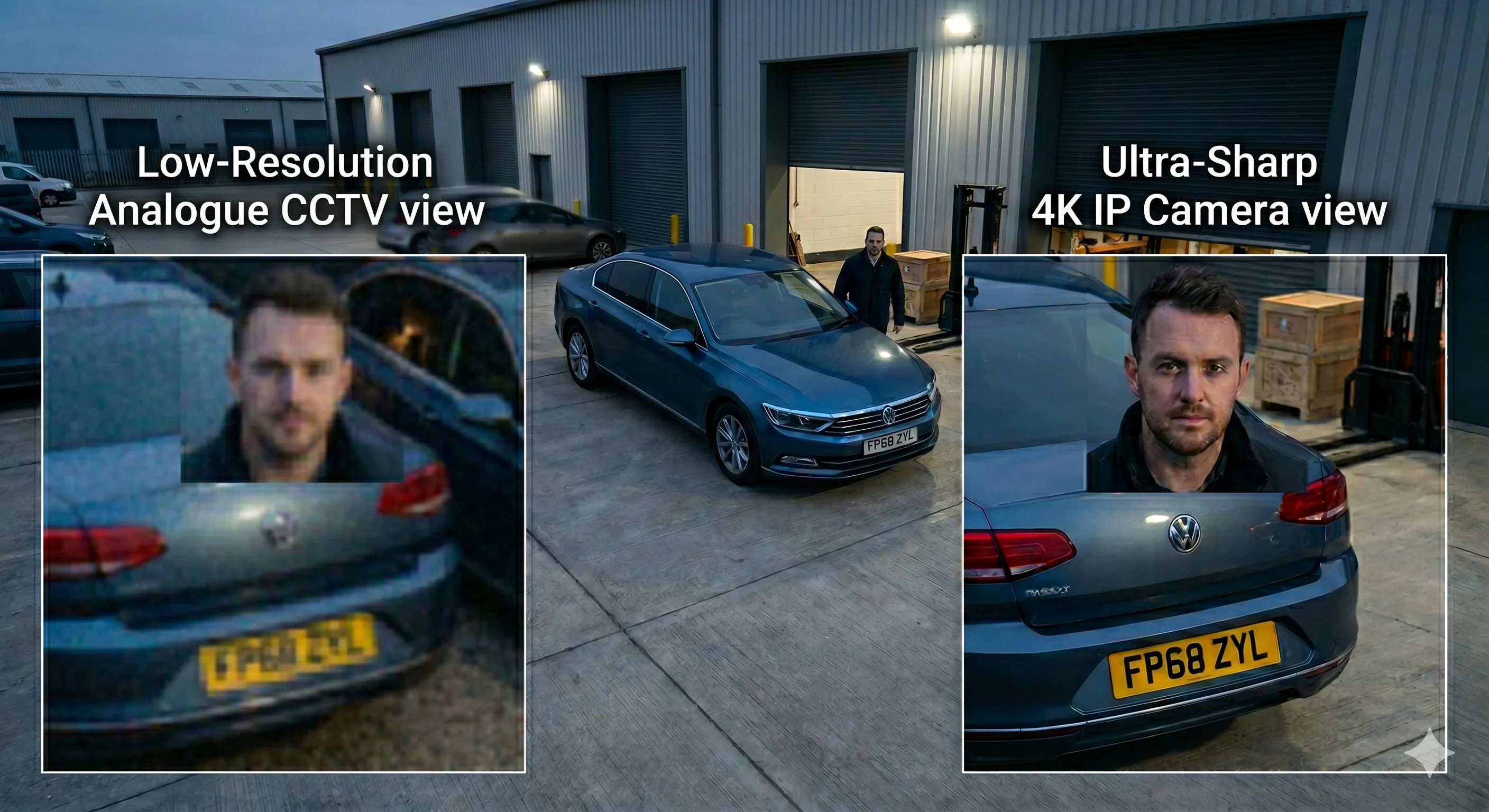
The single biggest difference between IP cameras and analogue CCTV is resolution. Traditional analogue cameras topped out at 960H - roughly 460,000 pixels. Modern HD-over-coax formats (HD-TVI, HD-CVI, AHD) pushed that to 1080p, matching entry-level IP cameras at around 2.1 megapixels. But IP cameras keep going: 4MP, 4K (8MP), and even 12MP+ models are now widely available. If you need to read a number plate from 30 metres or identify a face in a crowd, only IP delivers the pixel density required.
| Camera Type | Resolution | Pixel Count | Best For |
|---|---|---|---|
| Analogue 960H | 960 × 480 | ~460K | Legacy systems only |
| HD-TVI / CVI 1080p | 1920 × 1080 | ~2.1M | General monitoring, existing coax |
| IP 4MP | 2560 × 1440 | ~3.7M | Driveways, retail, small business |
| IP 4K / 8MP | 3840 × 2160 | ~8.3M | Number plates, facial ID, wide areas |
| IP 12MP+ | 4000 × 3000 | ~12M | Panoramic, city-centre monitoring |
Resolution matters most when you need to zoom in after an incident. A 4K IP camera captures four times the detail of a 1080p analogue camera. That means the difference between a blurry shape and a clear face - a distinction that police evidence teams care about deeply.
Cable Runs and Infrastructure: Where Analogue Still Wins
Here is where analogue systems have a genuine, practical advantage. RG59 coaxial cable supports reliable video signal transmission over 250 metres. Step up to RG6 and you reach 350 metres; RG11 stretches to 500 metres. IP cameras running over Cat5e or Cat6 with PoE (Power over Ethernet) are limited to 100 metres - the IEEE 802.3af/at standard hard ceiling. PoE extenders can push that to around 200 metres, but they add cost and complexity.
| Cable Type | Max Distance | Carries Power? | Best For |
|---|---|---|---|
| RG59 coax (analogue) | 250m (820ft) | Separate PSU required | Standard analogue runs |
| RG6 coax (analogue) | 350m (1,150ft) | Separate PSU required | Longer runs, larger sites |
| Cat5e/Cat6 PoE (IP) | 100m (328ft) | Yes - single cable | Standard IP installations |
| Cat6 + PoE extender | ~200m (654ft) | Yes - with repeater | Extended IP runs |
For large properties - farms, warehouses, industrial estates - where cameras sit 200+ metres from the recorder, existing coax infrastructure makes analogue HD (or a structured cabling upgrade) the pragmatic choice. Running new Cat6 over those distances requires fibre-to-copper media converters at each point, significantly increasing both cost and installation time.
Many modern DVRs are "pentabrid" - they accept analogue, HD-TVI, AHD, HD-CVI, and IP feeds simultaneously. This lets you keep existing analogue cameras on their coax runs while adding IP cameras on new positions. You migrate gradually instead of ripping everything out at once.
What Does a CCTV System Actually Cost in 2026?
Cost is the question every homeowner and business owner asks first. The price gap between IP and analogue has narrowed considerably, but IP systems still carry a premium - particularly once you factor in network infrastructure. Here is what a professional installation typically costs in 2026.
Per-camera hardware costs
| Camera Type | Budget | Mid-Range | Professional |
|---|---|---|---|
| Analogue HD (1080p TVI) | $30–60 (£25–50) | $60–120 (£50–95) | $120–250 (£95–200) |
| IP 2MP / 1080p | $60–100 (£50–80) | $100–200 (£80–160) | $200–400 (£160–320) |
| IP 4MP | $80–150 (£65–120) | $150–300 (£120–240) | $300–600 (£240–480) |
| IP 4K / 8MP | $120–200 (£95–160) | $200–450 (£160–360) | $450–900 (£360–720) |
Five-year total cost of ownership: 8-camera system
| Component | Analogue (1080p TVI) | IP (4MP PoE) |
|---|---|---|
| 8 cameras | $480–960 (£385–770) | $800–2,400 (£640–1,920) |
| Recorder + 2TB storage | $200–350 (£160–280) DVR | $350–500 (£280–400) NVR |
| Cabling + installation | $1,200–1,800 (£960–1,440) | $800–1,500 (£640–1,200) |
| PoE switch | N/A | $100–250 (£80–200) |
| Maintenance (5 years) | $500–1,000 (£400–800) | $400–800 (£320–640) |
| 5-year total | $2,600–4,500 (£2,080–3,600) | $2,750–6,050 (£2,200–4,840) |
The overlap is revealing. A budget analogue system and a budget IP system cost roughly the same. The premium for IP only becomes significant when you choose 4MP+ cameras and professional-grade NVRs. For many homes and small businesses, the price difference is modest enough that the decision comes down to features rather than budget.
AI Analytics: The Feature That Changes Everything
The most compelling reason to choose IP cameras in 2026 is on-camera AI analytics. Modern mid-range IP cameras - models costing $150–300 (£120–240) from brands like Ubiquiti, Hikvision, and Dahua - now run person detection, vehicle recognition, and line-crossing alerts directly on the camera's processor. This is edge AI: the camera itself decides whether movement is a person, a car, or a cat, and only sends meaningful alerts.

The practical impact is enormous. According to industry data from Premio Inc, AI-based filtering reduces false alarm rates by up to 90% compared to simple motion detection. That means your phone buzzes when a person approaches your front door - not when a fox crosses your garden at 3 a.m. Analogue systems have no equivalent capability; their DVRs rely on basic pixel-change motion detection, which triggers on everything.
What edge AI can do on a modern IP camera
- Person detection - distinguishes humans from animals, vehicles, and shadows
- Vehicle recognition - detects cars, vans, and motorcycles entering a zone
- Line crossing - triggers when someone crosses a virtual boundary (e.g. a fence line)
- Intrusion detection - alerts when someone enters a defined area outside business hours
- Loitering detection - flags when someone remains in an area beyond a set threshold
- ANPR / number plate recognition - reads plates in real time on dedicated models
None of this is possible with analogue cameras. If you want smart alerts, automated notifications, or integration with wider building systems (access control, alarms, lighting), IP is the only path. For a deeper look at what a full CCTV system selection involves, see our comprehensive buyer's guide.
Cybersecurity: The Risk You Cannot Ignore With IP
Every IP camera is a networked device, and every networked device is an attack surface. The Akamai Security Intelligence Response Team has documented active exploitation of IP camera vulnerabilities throughout 2025 and 2026 - including a command injection flaw in Edimax IC-7100 cameras (CVE-2025-1316) and GeoVision IoT vulnerabilities exploited by Mirai botnet variants.
The numbers are sobering. The "Aisuru" botnet - a Mirai descendant - compromised over 300,000 IoT devices and launched a 31.4 Tbps DDoS attack on Cloudflare in February 2026, with IP cameras among the most common victims. The root causes remain the same year after year: default passwords left unchanged, firmware never updated, and end-of-life devices with no security patches available.
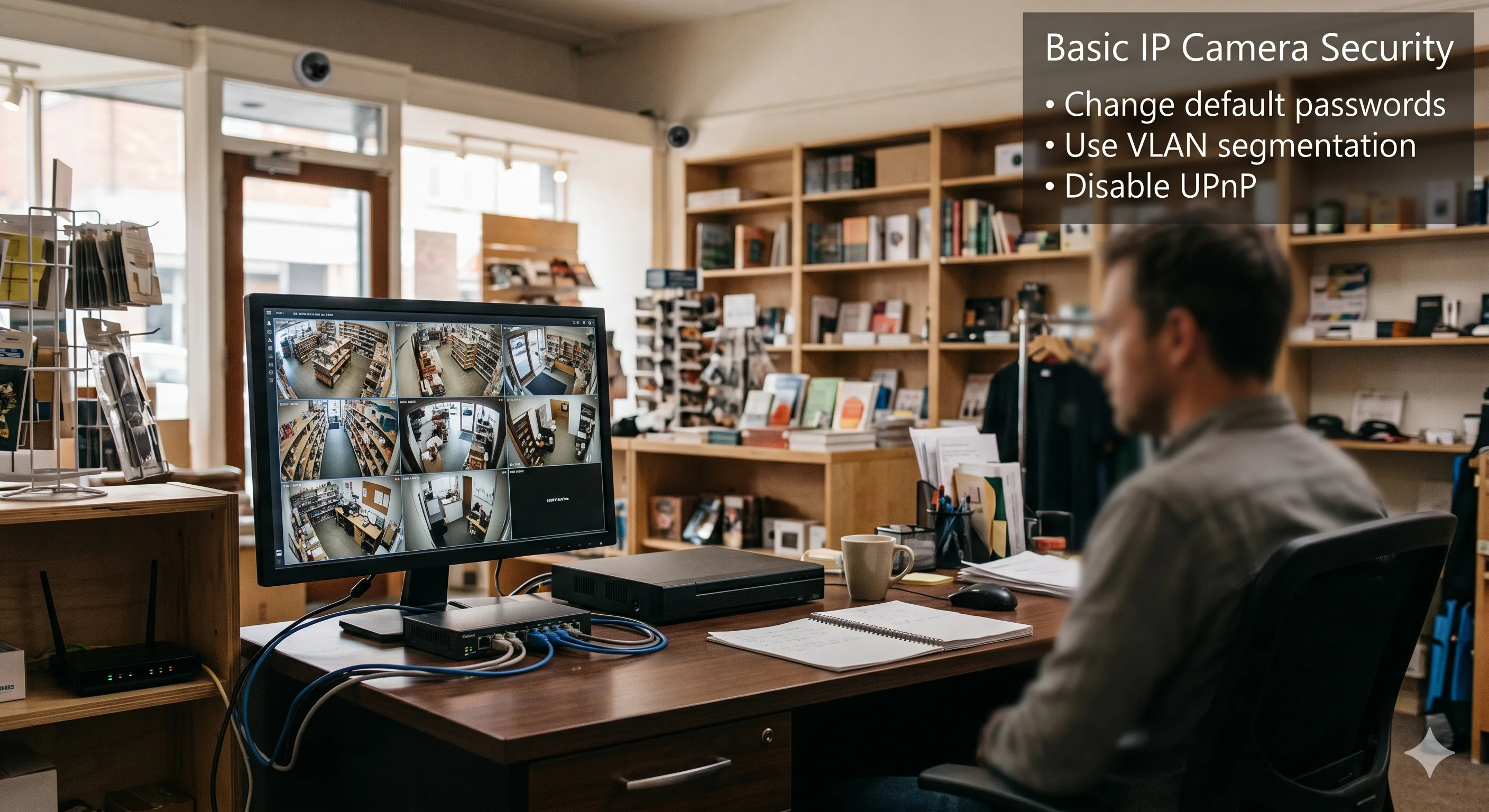
Change default credentials immediately - every camera, every NVR, every admin panel. Use unique passwords for each device. Segment your camera network with a dedicated VLAN - never put cameras on the same network as your computers and phones. Keep firmware updated - enable auto-update where available. Disable UPnP - it punches holes in your firewall without your knowledge. Consider a professionally configured network to ensure proper segmentation from day one.
Analogue cameras, by contrast, have zero cybersecurity risk. They are not network devices. They transmit an analogue signal over coax to a local DVR. There is nothing to hack remotely. For high-security environments where network exposure is unacceptable - or where IT resources for ongoing patch management do not exist - this remains a valid argument for analogue.
Bandwidth, Storage, and the Hidden Cost of 4K
Higher resolution means more data. A single 4K IP camera at 30fps generates 8–12 Mbps of H.264 video - or 4–6 Mbps with the more efficient H.265 codec. Multiply that by eight cameras and you need a dedicated network segment capable of handling 32–96 Mbps of sustained throughput, plus sufficient storage.
| Resolution | Bandwidth (H.264) | Bandwidth (H.265) | Monthly Storage (Continuous) |
|---|---|---|---|
| 1080p | 2–4 Mbps | 1–2 Mbps | 60–100 GB per camera |
| 4MP | 4–8 Mbps | 2–4 Mbps | 150–250 GB per camera |
| 4K / 8MP | 8–12 Mbps | 4–6 Mbps | 300–500 GB per camera |
Analogue systems sidestep this entirely. The video signal stays on the coax and is recorded directly by the DVR - no network bandwidth consumed, no switches to configure, no risk of network congestion affecting recording quality. For a home with limited network capacity, this simplicity has real value.

UK Legal Requirements: What the Law Says About CCTV
Whether you choose IP or analogue, the legal framework is the same. In the UK, any CCTV system that captures images of identifiable people is processing personal data. Three pieces of legislation govern this:
- Data Protection Act 2018 + UK GDPR - CCTV footage of identifiable individuals is personal data. You must have a lawful basis for processing it (typically "legitimate interests"), keep it only as long as necessary, and respond to subject access requests within one month.
- Protection of Freedoms Act 2012 - establishes the Surveillance Camera Commissioner and the Surveillance Camera Code of Practice, which contains 12 guiding principles. While legally binding on police and local authorities, the ICO expects all organisations to follow it as best practice.
- BS 8418 - the BSIA standard for remotely monitored detector-activated CCTV systems. Required if your system is professionally monitored and linked to police response.
Display clear signage showing who operates the system and how to contact them. Do not point cameras at neighbours' property or public footpaths unless there is a clear security justification. Set a retention period (typically 30 days for domestic, 31 days for business) and auto-delete older footage. Document your privacy impact assessment. These rules apply equally to IP and analogue systems - the technology is irrelevant; the data protection obligation is the same.
When Should You Choose Analogue CCTV?
Analogue HD systems (HD-TVI, HD-CVI, AHD) remain the right choice in several specific scenarios:
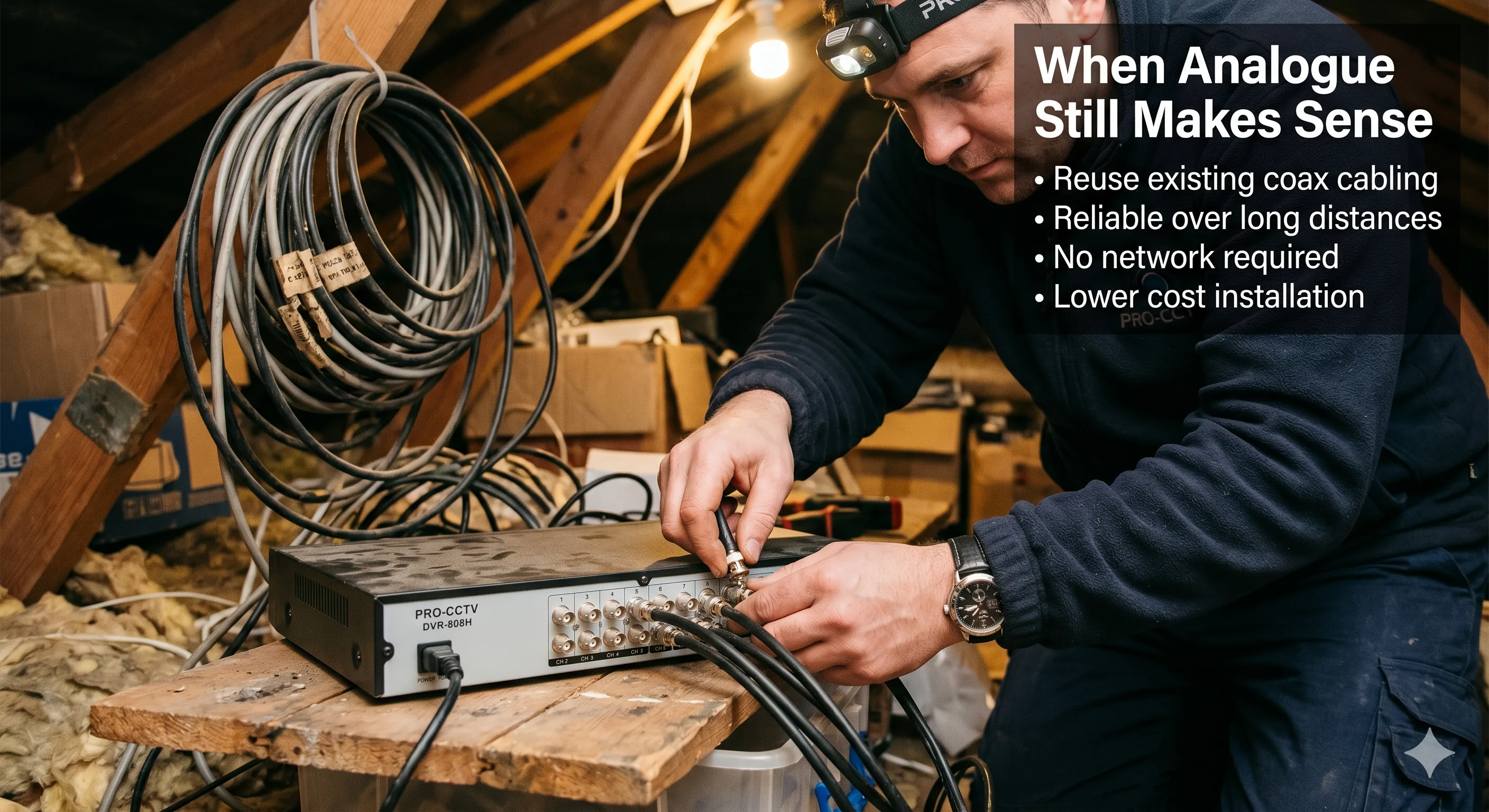
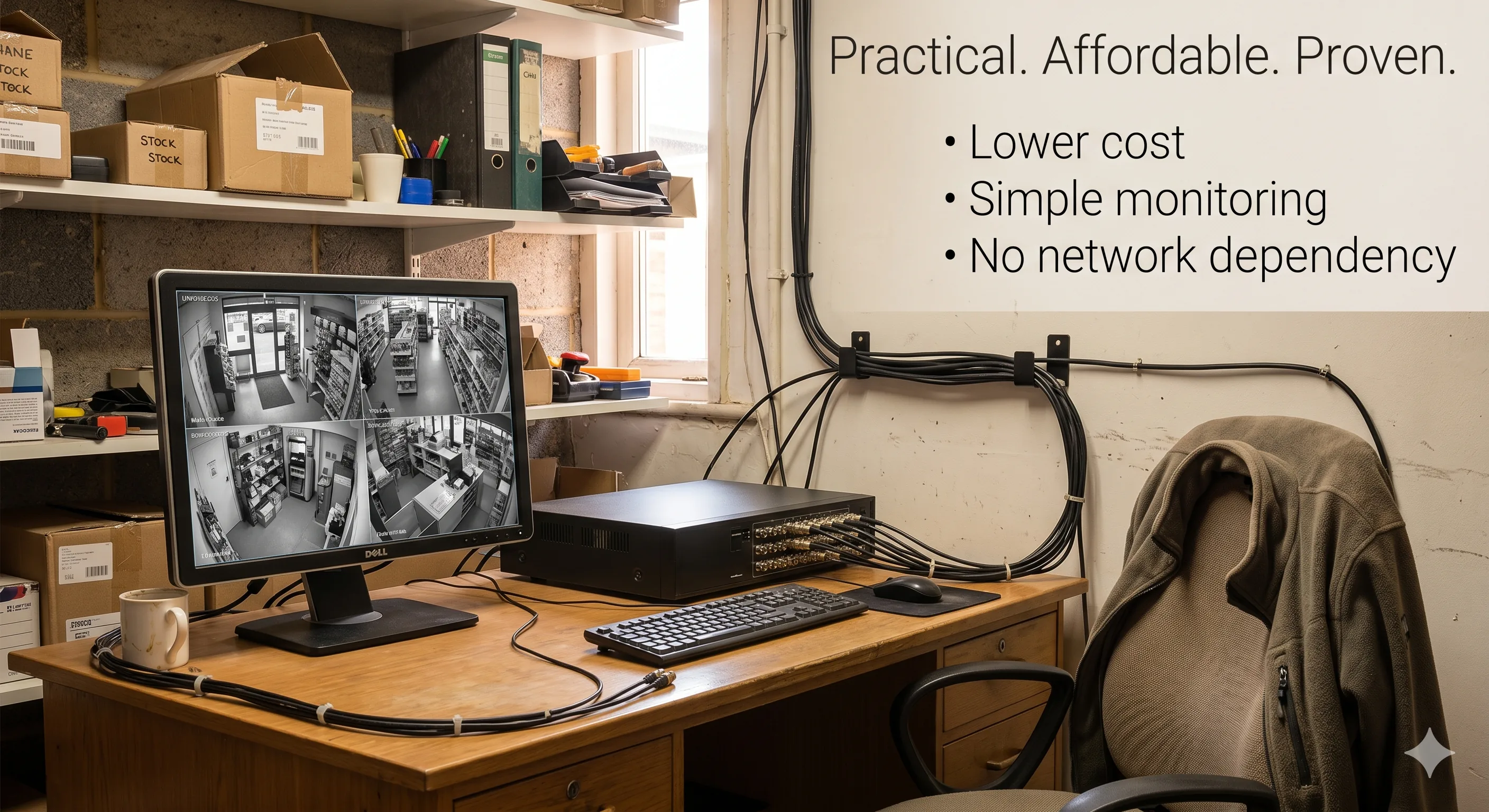
- Existing coax infrastructure - if your property already has coax runs from a previous system, replacing cameras alone (keeping the cables) is significantly cheaper than running new Cat6
- Very long cable runs - distances beyond 100 metres without fibre infrastructure
- No network infrastructure - rural properties, outbuildings, or sites without Ethernet
- Tight budgets - when every dollar matters and 1080p is sufficient for the application
- Zero cyber risk tolerance - environments where putting any additional device on the network is unacceptable
- Simple monitoring only - no remote access, no analytics, no integration required
When Should You Choose IP Cameras?
IP cameras are the right choice when you need capabilities that analogue simply cannot deliver:
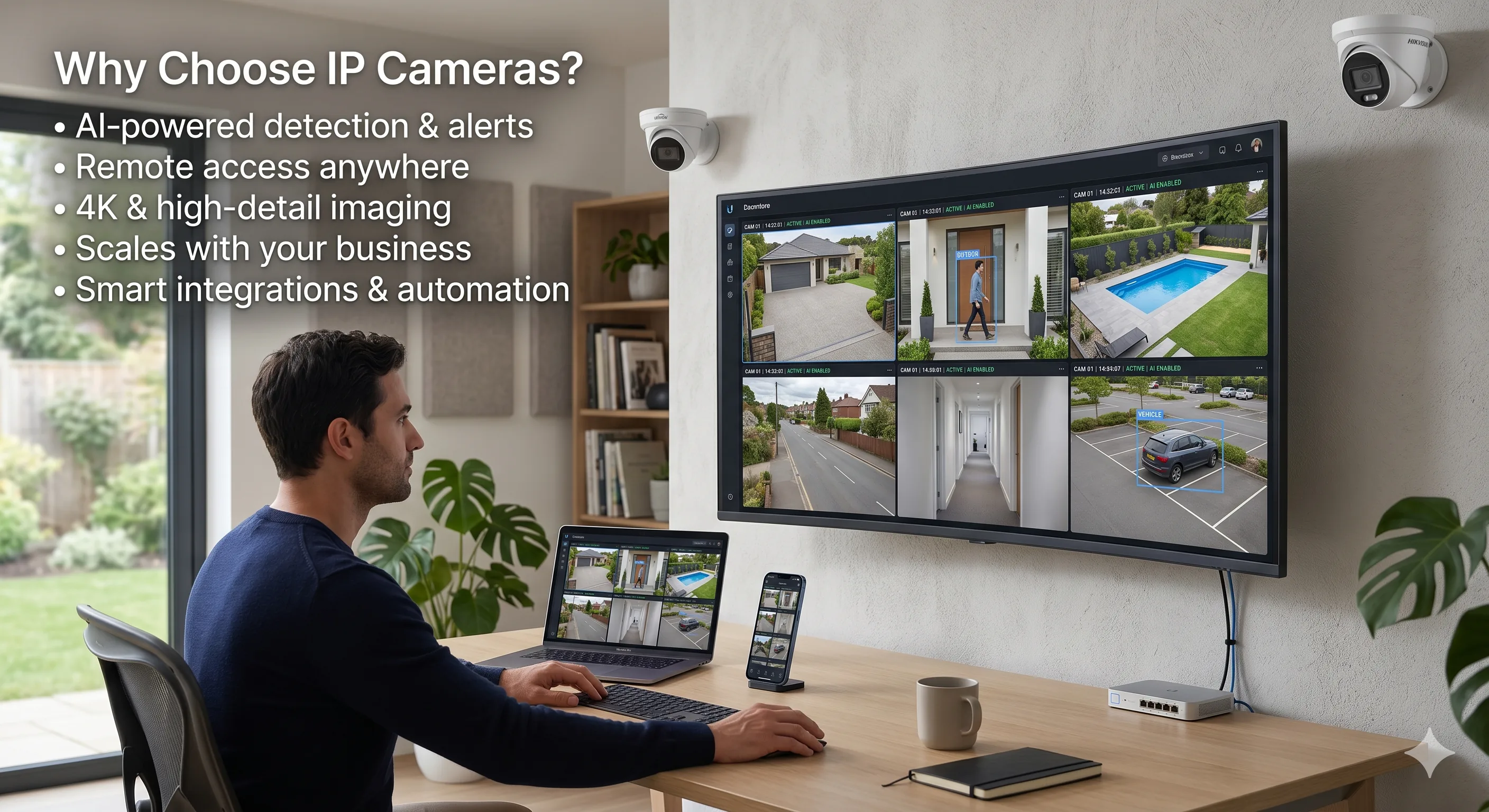
- AI analytics - person detection, vehicle recognition, line crossing, smart home integration
- Remote access - viewing live feeds and playback from anywhere on your phone or laptop
- Resolution above 1080p - 4MP, 4K, and beyond for critical identification needs
- Scalability - systems beyond 16 cameras, or where cameras will be added over time
- Integration - connecting CCTV with access control, smart home devices, alarms, or building management
- Multi-site management - a single dashboard for cameras across multiple locations
- Night vision quality - starlight sensors and smart IR for colour imaging at near-zero lux
The Hybrid Approach: Best of Both Worlds
In practice, many professional installations in 2026 use a hybrid approach. Modern "pentabrid" DVRs from manufacturers like Hikvision and Dahua accept analogue, HD-TVI, AHD, HD-CVI, and IP inputs simultaneously. This means you can:
- Keep existing analogue cameras on their coax runs - no rewiring needed
- Add IP cameras at new positions where you need higher resolution or analytics
- Migrate gradually - replace analogue cameras one at a time as budget allows
- Use Ethernet-over-Coax (EoC) adapters to run IP cameras over existing coax at up to 500 metres
This is the approach we recommend most often for residential and small business CCTV installations. It protects existing investment while opening the door to modern features. For businesses already running managed Wi-Fi networks, adding IP cameras to the existing infrastructure is straightforward.
What a Professional Installer Would Recommend
After fitting hundreds of systems across homes and businesses, here is the honest recommendation: IP is the default choice for new installations in 2026. The price gap has closed enough that the benefits - higher resolution, AI analytics, remote access, future-proofing - justify the modest premium for most buyers. The video analytics sub-market alone is projected to reach $14.9 billion (£11.9 billion) by 2026, according to MarketsandMarkets. That growth reflects genuine demand for smarter surveillance.
But if you already have working coax runs, a tight budget, cable distances over 100 metres, or simply no interest in remote access and smart alerts - analogue HD is perfectly capable. A well-installed 1080p HD-TVI system with good camera placement still delivers reliable security footage that police can use.
The worst outcome is a poorly installed system of either type. Camera placement, cable quality, recorder configuration, and network reliability matter far more than whether the signal is digital or analogue. A professional survey and installation ensures you get a system that works correctly from day one - and keeps working for years.
Our professional IP CCTV installation service covers Greater London and the M25 corridor. Request a free consultation →