

Artificial intelligence is no longer the preserve of tech giants with seven-figure R&D budgets. According to the British Chambers of Commerce, 54% of UK firms are now actively using AI - up from just 23% in 2023. For small businesses in particular, the question has shifted from "should we adopt AI?" to "where will it actually pay off?" This guide to AI for small business cuts through the hype with practical use cases, real cost data, and an honest look at where AI delivers genuine return on investment.
British Chambers of Commerce, 2026
Thryv Survey, 2025
OECD SME Survey, 2025
The State of AI Adoption in UK Small Businesses
The adoption curve has steepened dramatically. The OECD reports that 20.2% of all firms across member nations used AI in 2025, up from 8.7% in 2023. But there is a clear size gap: 40% of firms with 250+ employees have adopted AI, compared to just 11.9% of those with 10–49 staff.
In the UK specifically, the picture is mixed. The Department for Science, Innovation and Technology (DSIT) puts the official figure at one in six businesses currently using AI. Perhaps more tellingly, 87% of those describe their AI as only partially integrated - and 71% of non-users say they have not identified a clear use case.
That last statistic is the key insight. The barrier to AI adoption is not cost - a ChatGPT Business subscription costs less than a mobile phone contract. The barrier is knowing where to start.
Five AI Automation for Business Use Cases That Actually Deliver ROI
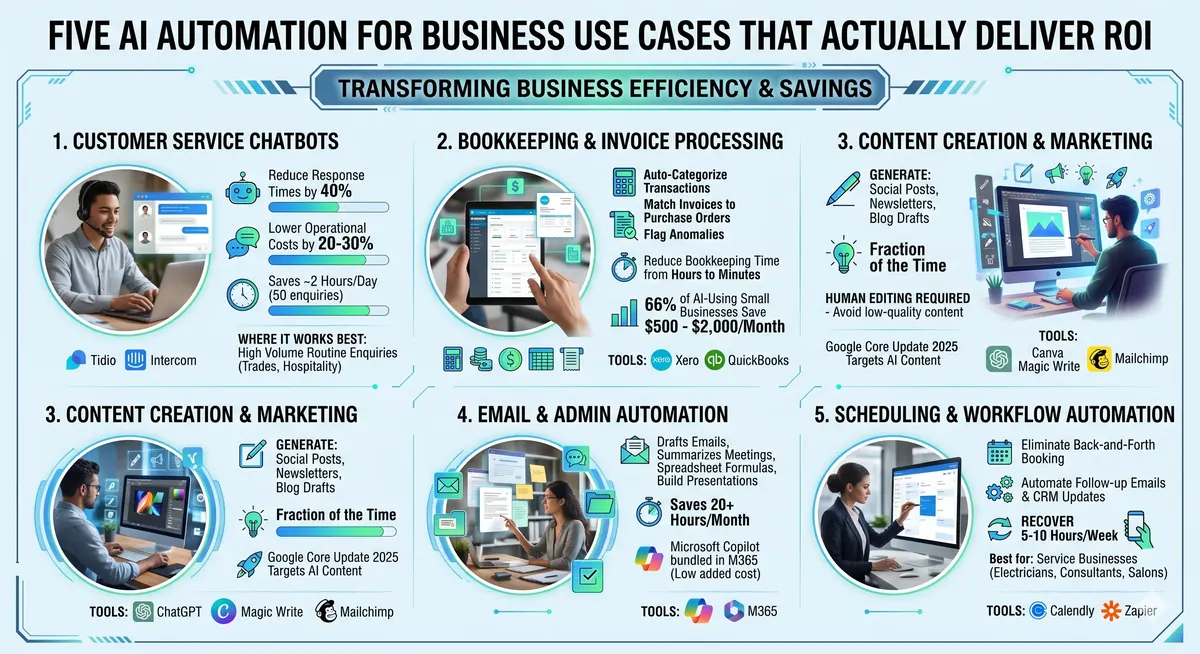
Not all AI applications are created equal. Based on the Thryv 2025 survey of 540 small businesses, the three most common use cases are data analysis (62%), content generation (55%), and customer engagement via chatbots (46%). Here are the five that consistently justify their cost.
1. Customer Service Chatbots
An AI chatbot for business is the fastest path to measurable savings - and most can be deployed in minutes. A peer-reviewed study published in MDPI Information found that AI chatbots reduce customer response times by 40% and lower operational costs by 20–30% for SMEs. For a business handling 50 enquiries a day, that translates to roughly two fewer hours of staff time - every day.
Tools like Tidio and Intercom offer AI chatbot plans from around $30/month (£25). They handle frequently asked questions, booking confirmations, and basic troubleshooting - the repetitive queries that consume disproportionate staff time.
Businesses with high volumes of routine enquiries - trades, hospitality, professional services. If your team answers the same ten questions every day, a chatbot pays for itself in the first week.
2. Bookkeeping and Invoice Processing
AI-powered accounting tools from Xero and QuickBooks now auto-categorise transactions, match invoices to purchase orders, and flag anomalies. For a sole trader or small team, this can reduce bookkeeping time from several hours a week to a quick review.
The Thryv survey found that 66% of AI-using small businesses save between $500 and $2,000 per month in operational costs. Bookkeeping automation is a primary driver of these savings - it eliminates data entry, reduces errors, and removes the need for a part-time bookkeeper for many micro-businesses.
3. Content Creation and Marketing
Content generation is the second most popular use case (55% of AI-using SMEs). Tools like ChatGPT, Canva's Magic Write, and Mailchimp's AI features help small businesses produce social media posts, email newsletters, product descriptions, and blog drafts at a fraction of the time.
The caveat: AI-generated content requires human editing. Google's December 2025 Core Update specifically targets low-quality AI content. Use AI to accelerate your first draft - never to replace your voice entirely.
4. Email and Admin Automation
Microsoft Copilot - now bundled into Microsoft 365 subscriptions - drafts emails, summarises meeting notes, creates spreadsheet formulas, and builds presentations from prompts. For businesses already paying for Microsoft 365, this is effectively AI at no additional cost beyond a small per-user uplift.
The Thryv data shows 58% of AI-using small businesses save 20 or more hours per month. Email drafting, meeting summaries, and document formatting are the unglamorous tasks where those hours accumulate.
5. Scheduling and Workflow Automation
Business AI automation tools like Calendly with AI assistant features and workflow platforms like Zapier eliminate the back-and-forth of appointment booking, follow-up emails, and CRM updates. For service businesses - electricians, consultants, salon owners - this alone can recover five to ten hours a week.

The Real Cost of AI Tools for Small Businesses
One of the most common misconceptions is that AI requires significant investment. The reality is that the commodity tier - ChatGPT, Copilot, Gemini - now sits at around $20–25 (£16–20) per user per month. That is less than most businesses spend on coffee.
| Category | Example Tools | Typical Cost | Time Saved |
|---|---|---|---|
| General AI assistant | ChatGPT Business, Microsoft Copilot, Google Gemini | $20–30 (£16–25)/user/month | 5–10 hrs/week |
| Customer chatbot | Tidio, Intercom, Crisp | $30–100 (£25–80)/month | 2–4 hrs/day |
| Bookkeeping AI | Xero AI, QuickBooks AI | $15–45 (£12–35)/month | 3–6 hrs/week |
| Marketing automation | Mailchimp, HubSpot, Canva | $12–65 (£10–50)/month | 4–8 hrs/week |
| Workflow automation | Zapier, Make, Calendly | $20–50 (£15–40)/month | 5–10 hrs/week |
For a typical small business using two or three tools, the total cost ranges from $50 to $150 (£40–120) per month. Against that, the Thryv survey reports median savings of $500–$2,000/month - a return of four to sixteen times the investment.
Where AI Falls Short - The Honest Truth
The hype around AI often obscures an uncomfortable reality: many AI projects underperform. Gartner found that only 28% of AI use cases in operations fully succeed and meet ROI expectations, while 20% fail outright. The most common reason? Expecting too much, too fast - cited by 57% of leaders whose AI projects failed.
McKinsey's 2025 Global Survey is equally revealing: 88% of organisations now use AI in at least one function, but only 39% see any measurable impact on earnings. The critical difference? Businesses that redesign workflows around AI are twice as likely to see returns than those who simply bolt AI onto existing processes.
Common pitfalls to avoid
- Adopting AI without a specific problem to solve. The OECD reports that 67% of non-users are unsure how to use AI or assess its risks. Start with one clear pain point.
- Treating AI as a replacement for skills. AI augments competent staff - it does not compensate for a lack of process discipline.
- Ignoring the learning curve. UK Government research shows 60% of businesses cite limited AI skills as a key blocker. Budget time for training, not just the subscription.
- Scaling too quickly. Gartner predicted that 30% of generative AI projects would be abandoned after proof-of-concept by end of 2025. Prove ROI on one tool before adding others.
Redesign the workflow first, then apply AI. Bolting artificial intelligence onto a broken process just automates the inefficiency. Businesses that restructure their workflows before deploying AI are twice as likely to see earnings impact, according to McKinsey.
AI and Jobs - What the Data Actually Says
The fear that AI will eliminate small business jobs is not supported by current evidence. The Thryv survey found that 82% of small businesses using AI actually increased their workforce rather than reducing it. The OECD echoes this: 91% of SMEs using generative AI report efficiency gains, while 76% cite increased innovation.
The pattern is consistent: AI handles repetitive, low-value tasks (data entry, routine enquiries, scheduling), freeing staff to focus on higher-value work - client relationships, complex problem-solving, business development. For small businesses where every team member wears multiple hats, this reallocation of time can be transformative. For practical examples, see our guide to AI in the home and smart home technology.
How to Get Started - A Practical Roadmap
Based on the data above, here is a step-by-step approach for any small business owner considering AI for the first time.
Step 1: Audit your time
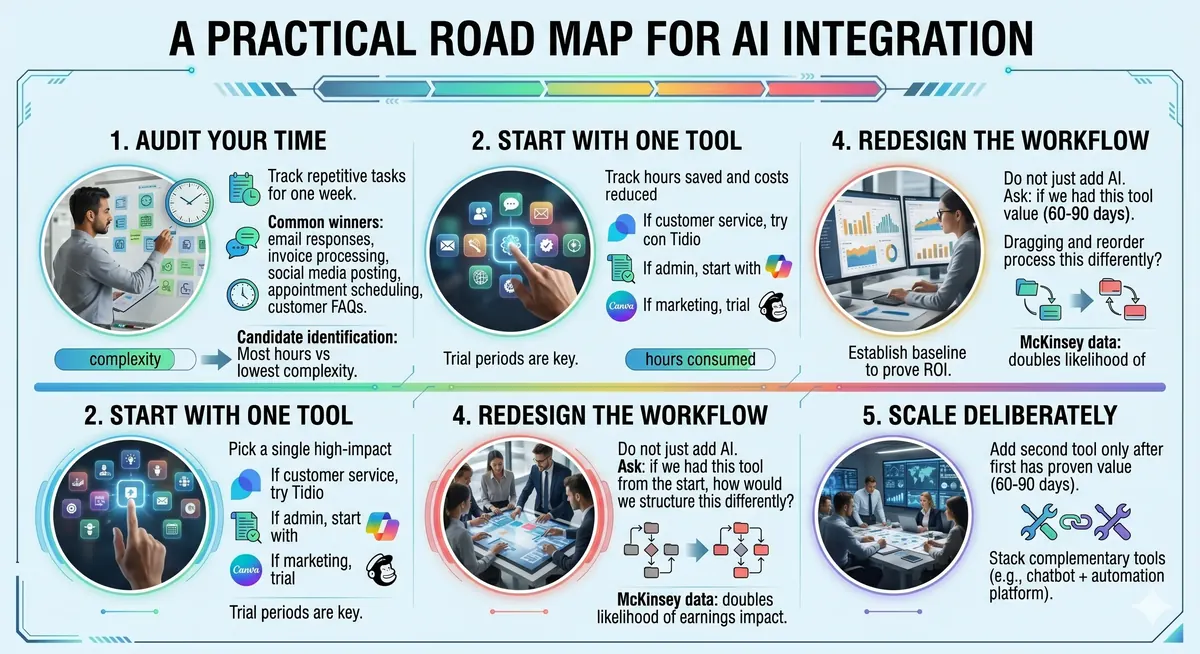
For one week, track where your team spends time on repetitive tasks. Common winners: email responses, invoice processing, social media posting, appointment scheduling, customer FAQs. The task that consumes the most hours relative to its complexity is your best AI candidate.
Step 2: Start with one tool
Pick a single AI tool that addresses your highest-impact task. If it is customer service, try Tidio. If it is admin, start with Microsoft Copilot. If it is marketing, trial Canva or Mailchimp's AI features. Most offer free trials or low-cost starter plans.
Step 3: Measure before and after
Track hours saved and costs reduced over 30 days. Be specific: "We spent 12 hours a week on email responses before AI; now it takes 4 hours." This baseline proves (or disproves) ROI and justifies expanding to additional tools.
Step 4: Redesign the workflow
Do not just add AI to the existing process. Ask: if we had this tool from the start, how would we structure this workflow differently? McKinsey's data shows this single step doubles the likelihood of seeing earnings impact.
Step 5: Scale deliberately
Only add a second AI tool once the first has proven its value over 60–90 days. Stack tools that complement each other - for example, a chatbot for customer service and an automation platform for the follow-up workflow.
(£40–120)
Thryv Survey, 2025
What Comes Next
The US Federal Reserve reports that the gap between small and large business AI adoption is closing faster than any previous technology cycle - from a 1.8x gap in early 2024 to near parity by late 2025. The OECD confirms that 31% of SMEs now use generative AI specifically, a 40% rise year-on-year.
For any AI for small business adopter, the window of competitive advantage is narrowing. Explore our full range of AI services and technology solutions to see how we help businesses get started. Early adopters who identify clear use cases, invest modestly, and measure results are building an efficiency edge that compounds over time. Those who wait for AI to "mature" risk finding themselves competing against businesses that are simply faster, cheaper, and more responsive.
The technology is ready. The tools are affordable. The only question is whether you will deploy them strategically - or not at all.
Batra.ai helps small businesses across Greater London and the M25 corridor integrate AI tools into their existing workflows. Book a free consultation →