
Walk through any electronics retailer in 2026 and you'll struggle to find a product that doesn't claim to use artificial intelligence. Toasters, doorbells, light bulbs, refrigerators — the "AI" label has become the new "HD," slapped on everything regardless of whether there's any genuine machine learning under the hood. The global smart home market is now worth over $180 billion, according to Fortune Business Insights, and nearly eight in ten UK households now own at least one smart home product, per YouGov UK research. But ownership and usefulness are very different things.
value (2026 est.)
least one smart device
Wi-Fi / connectivity issues
That last number is the one manufacturers don't want you to think about. Nearly half of smart device owners report persistent connectivity problems — and when devices don't work reliably, they end up gathering dust. Add in the fact that 69% of users are juggling multiple ecosystems (a recipe for digital fatigue), and it's clear that ownership and usefulness are very different things. So let's cut through the noise and look at what's actually worth your money — and what isn't.
What Genuinely Works
Not everything labelled "AI" is marketing fluff. A handful of product categories have matured to the point where the underlying machine learning delivers measurable, repeatable value. These are the ones worth investing in.
Smart Thermostats That Learn Your Schedule
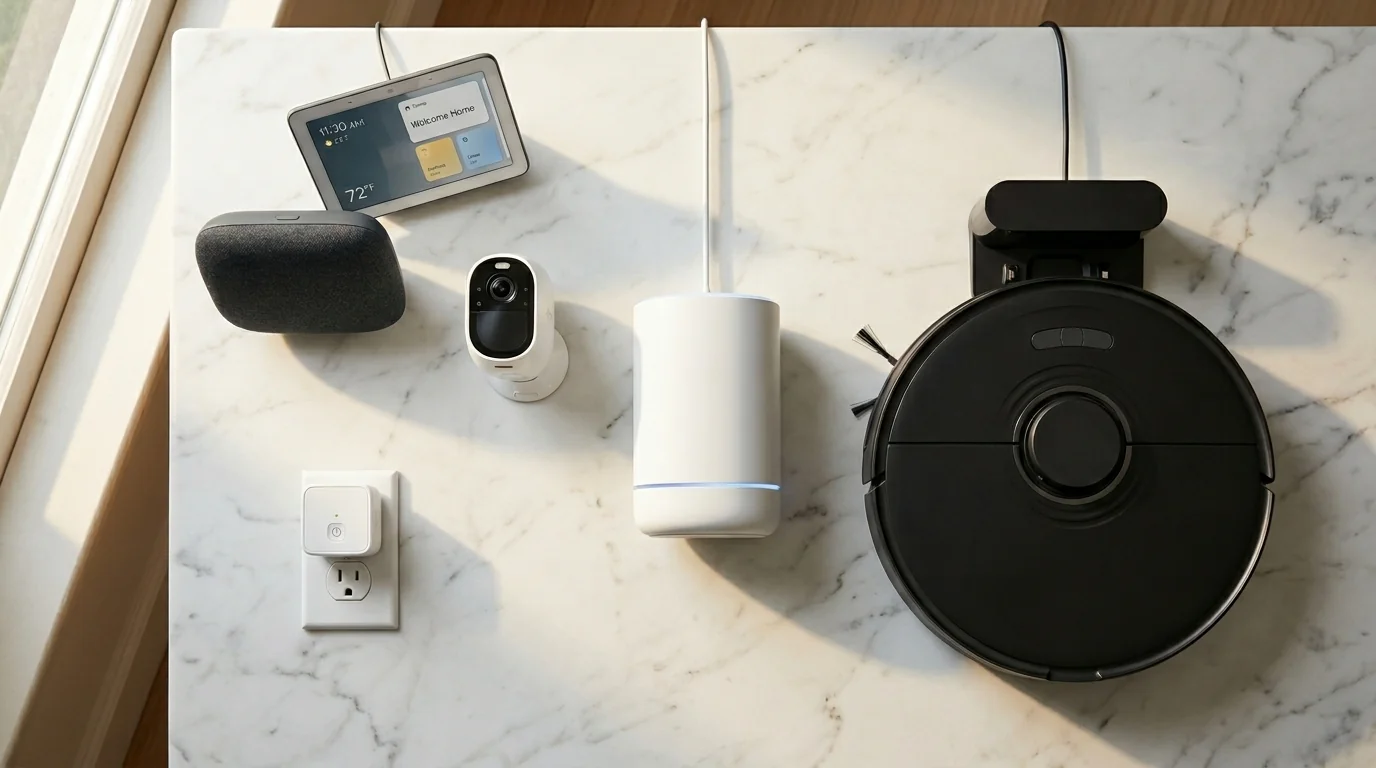
This is the poster child for AI in the home done right. Devices like the Nest Learning Thermostat and Ecobee Premium use occupancy sensors and behavioural pattern recognition to build a model of when you're home, when you're away, and what temperatures you prefer at different times. The result isn't theoretical: Independent utility studies show Nest users save 10–12% on heating and up to 15% on cooling, with the EPA's ENERGY STAR programme certifying an average 8% reduction in heating and cooling costs across all smart thermostats.
What makes this genuinely "AI" rather than a fancy timer is the adaptation. A smart thermostat learns that you come home at 17:30 on weekdays but 14:00 on Fridays. It pre-heats accordingly without you programming a single schedule. It detects when you've gone on holiday. It adjusts for outside temperature. After two weeks of use, most people never touch the controls again — and that's the point.
Proven energy savings, pays for itself within 12–18 months. The AI here is doing real work — learning patterns, predicting behaviour, and reducing waste without any ongoing effort from you.
Robot Vacuums with LiDAR Navigation
The gap between a cheap robot vacuum and a modern LiDAR-equipped one is enormous. Models from Roborock, Ecovacs, and iRobot now use simultaneous localisation and mapping (SLAM) — the same technology self-driving cars rely on — to build real-time floor plans of your home. They know where the sofa is, where the dog's water bowl sits, and which rooms they've already cleaned.
The practical benefit is substantial. AI-powered models complete a full clean in 30–40% less time than random-bounce robots and miss far fewer spots. Object avoidance has improved dramatically too — 2026 models can detect and navigate around cables, shoes, and pet waste using onboard cameras and neural networks. Which? now rates several AI-equipped models as performing comparably to a thorough manual vacuum on hard floors.
Genuine time-saver with measurable cleaning improvements over non-AI models. The LiDAR mapping and object avoidance are real AI capabilities, not marketing.
AI Security Cameras (Person and Vehicle Detection)
This is where AI has perhaps made the most dramatic improvement. Traditional motion-activated cameras send you alerts every time a cat walks past, a branch sways, or a car's headlights sweep across the lens. AI-equipped cameras from Ring, Arlo, Reolink, Hikvision & Ubiquiti (UniFi) use on-device neural networks to classify what triggered the motion: person, vehicle, animal, or irrelevant movement.
The difference in daily usability is transformative. False alert rates drop by 70–90% compared to simple motion detection, with the College of Policing noting that 94–98% of traditional alarm-triggered police responses are false alarms — a problem AI classification largely eliminates. When you do get a notification, it's because a person is actually on your property — not because a fox trotted past at 3 a.m. Some systems can now distinguish between household members, delivery drivers, and strangers, sending different alert priorities for each.
If your cameras capture footage of public areas (pavements, neighbours' property), you have obligations under UK GDPR and the Data Protection Act 2018. The ICO's domestic CCTV guidance is the definitive reference. AI classification doesn't exempt you from data protection law.
On-device person detection is the single biggest quality-of-life improvement in home security since the smartphone app. Dramatically fewer false alerts, genuinely useful notifications.
Adaptive Wi-Fi Mesh Networks
Mesh systems from Ubiquiti (UniFi), TP-Link Deco, Eero, and Google Nest WiFi Pro now use AI-driven channel optimisation to automatically steer devices between nodes, switch frequency bands, and avoid interference from neighbouring networks. Unlike earlier "smart" routers that simply picked a channel at setup, these systems continuously monitor network conditions and adapt in real time.
The result is fewer dead zones, more consistent speeds across the house, and less buffering during peak usage. For households with 15–30 connected devices (increasingly typical in 2026), the difference between a static router and an adaptive mesh network is the difference between frequent frustration and simply forgetting about your Wi-Fi entirely — which is exactly how good networking should feel. Read our complete guide to eliminating Wi-Fi dead zones for setup recommendations.
AI channel optimisation solves a real problem (congestion, dead zones) without requiring any technical knowledge. Particularly worthwhile for larger homes or heavy device loads.
The Grey Area — Promising but Patchy
Some AI home products work well in specific scenarios but fall short of their marketing promises in others. These aren't bad purchases, but go in with realistic expectations.
Voice Assistants for Home Control
Alexa, Google Assistant, and Siri have become household fixtures — around 41% of UK households now have a smart speaker, according to Ofcom's 2025 Audio Report. For simple tasks — setting timers, playing music, checking the weather — they're excellent. For controlling smart home devices with single commands ("turn off the living room lights"), they're reliable.
Where they fall apart is anything complex. Multi-step routines often break. Natural conversation is still fragile — rephrase a command slightly and the assistant doesn't understand. The "AI" in these products is narrower than the marketing suggests; they're very good at a small set of tasks and mystifyingly bad at slight variations. If you already have a smart speaker, use it for what it does well. But don't buy one expecting a Star Trek computer.
Voice assistants are useful tools with clear limits. Expect competent voice control for simple commands; don't expect a reliable home automation brain.
AI-Powered Laundry and Cooking Appliances
Samsung and LG now sell washing machines that claim to detect fabric types and adjust cycles using AI. Some ovens promise to identify food and set the correct temperature. In practice, the results are mixed. The fabric detection works reasonably well for common materials but adds perhaps 5% improvement over manually selecting a cycle. The food recognition in ovens remains unreliable for anything beyond the most basic items.
These features aren't harmful — they're just not worth paying a £200–400 premium for. A good washing machine with a wool cycle and a temperature probe for your oven will get you 95% of the way there at a fraction of the cost.
If you're buying a new appliance anyway and the AI version is similarly priced, it won't hurt. But these features don't justify upgrading a working machine.
What's Still More Marketing Than Magic
These are the products where "AI" is doing the least work and the marketing department is doing the most. Approach with healthy scepticism.
"AI" Refrigerators
The connected fridge has been the tech industry's white whale for over a decade. Samsung's Bespoke AI Family Hub can recognise groceries via internal cameras and suggest recipes. In theory. In practice, it misidentifies items regularly, the camera angle makes it difficult to see everything, and the recipe suggestions are no better than a five-second search on your phone. At £2,000+ more than a comparable non-smart fridge, the value proposition is essentially a screen stuck to a refrigerator door.
The core problem is that a fridge's job — keeping food cold — hasn't benefited from AI in any meaningful way. Adaptive cooling that responds to how often you open the door is a thermostat, not artificial intelligence. Until a fridge can reliably track all your groceries, integrate with your shopping list, and alert you to expiry dates without constant manual correction, this category remains a solution looking for a problem.
The AI features don't work reliably enough to justify the enormous price premium. Buy a good fridge and use your phone for recipes.
AI Air Purifiers and "Smart" Lighting
Air purifiers that "use AI to detect pollution levels" are, in most cases, using a basic particulate sensor and a lookup table — not machine learning. The sensor detects PM2.5 levels rise and the fan speeds up. That's useful, but it's the same thing non-AI purifiers from Blueair and Philips have done for years.
Smart lighting systems like Philips Hue have dabbled in "AI scenes" that adapt to time of day and ambient light. The execution is reasonable but hardly transformative — a simple schedule achieves 90% of the same effect. Where smart lighting does shine (pun intended) is in occupancy-based automation: lights that turn on when you enter a room and off when you leave. But that's a motion sensor, not AI.
Both products can be useful, but the AI branding is largely cosmetic. A sensor-based purifier and a scheduled smart bulb do nearly the same thing at lower cost.
How to Spot AI Washing
The term "AI washing" — where companies exaggerate or fabricate AI capabilities in their products — has become enough of a concern that regulatory bodies are paying attention. The US Federal Trade Commission issued guidance warning companies about misleading AI claims, and the UK's Advertising Standards Authority has begun investigating similar concerns domestically.
Before buying any "AI-powered" home device, ask three questions:
- What specific problem does the AI solve? If the answer is vague ("optimises your experience"), be suspicious. Genuine AI products can point to concrete outcomes — 10% energy savings, 80% fewer false alerts, 35% faster cleaning.
- Does it learn and adapt over time? True machine learning improves with use. If the product behaves identically on day one and day one hundred, it's running rules, not AI.
- Could a simpler technology achieve the same result? A motion sensor is not AI. A timer is not AI. A thermostat that follows a schedule is not AI. If you strip the buzzword and the product still makes sense, the "AI" is probably decorative.
The Quick Reference: What to Buy, What to Skip
| Category | AI Usefulness | Verdict | Why |
|---|---|---|---|
| Smart thermostats | High | Buy | Proven 10–12% energy savings, genuine learning |
| Robot vacuums (LiDAR) | High | Buy | Real SLAM navigation, object avoidance |
| Security cameras | High | Buy | Person detection cuts false alerts 70–90% |
| Wi-Fi mesh (adaptive) | Medium–High | Buy | Continuous channel and band optimisation |
| Voice assistants | Medium | Mixed | Great for basics, poor for complex routines |
| AI laundry / ovens | Low–Medium | Don't overpay | Marginal improvement over manual settings |
| "AI" refrigerators | Low | Skip | Unreliable recognition, massive premium |
| AI air purifiers | Minimal | Skip the AI tax | Sensor + fan speed ≠ AI |
The Honest Verdict
AI in the home is not a gimmick — but it's not magic either. The technology genuinely excels when it solves a specific, well-defined problem: learning your heating patterns, mapping your floor plan, distinguishing a person from a fox. These are tasks where machine learning has a clear advantage over simpler approaches, and the products that do them well have earned their place in the smart home.
Where AI falls flat is in categories where the underlying problem doesn't need AI to begin with. Your fridge doesn't need to recognise bananas. Your air purifier doesn't need machine learning to respond to a particle count. Your light bulbs don't need neural networks to turn on at sunset.
The buying advice is simple: invest in AI that saves you time, energy, or money — and ignore AI that's there to justify a price tag. If you can't articulate what the AI is doing for you in a single sentence, you probably don't need it.
We help homes and SMEs automate the repetitive, respond faster, and grow without adding headcount — using practical, affordable AI solutions. Batra.ai covers a global customer base. Get a free quote →